Leverage lets a trader open a position larger than the money they put in. It also brings a price level that every leveraged trader should know before entering: the liquidation price. This guide explains what it is, how leverage moves it, why the real level is often closer than a simple estimate, and why a stop loss is a better exit. You can estimate it for your own numbers with the free liquidation calculator.
ALPHAVYN does not recommend using leverage. This article explains the risk so you can understand it, not to suggest a leverage level.
What is a liquidation price?
When you trade with leverage, you put up only part of the position's value. This deposit is called margin. The rest is effectively borrowed. If the price moves against you, the loss is taken from your margin.
The trading platform requires that a small minimum amount of margin always stays in the position. This is the maintenance margin. When the loss grows so large that the remaining margin falls to this minimum, the platform closes the position automatically. That forced close is liquidation, and the price where it happens is the liquidation price. The margin in the position is usually lost.
The idea is similar to the maintenance requirement in traditional margin accounts. The U.S. SEC's investor bulletin on margin accounts explains that if equity falls below the required minimum, positions can be sold, and the broker may not have to warn you first. In crypto, positions are often closed automatically and within seconds.
How does leverage move the liquidation price closer?
Leverage decides how much of the position your margin covers. At 10x, your margin is 10% of the position, so a move of about 10% against you uses it up. At 50x, your margin is only 2%, so a move of about 2% is enough.
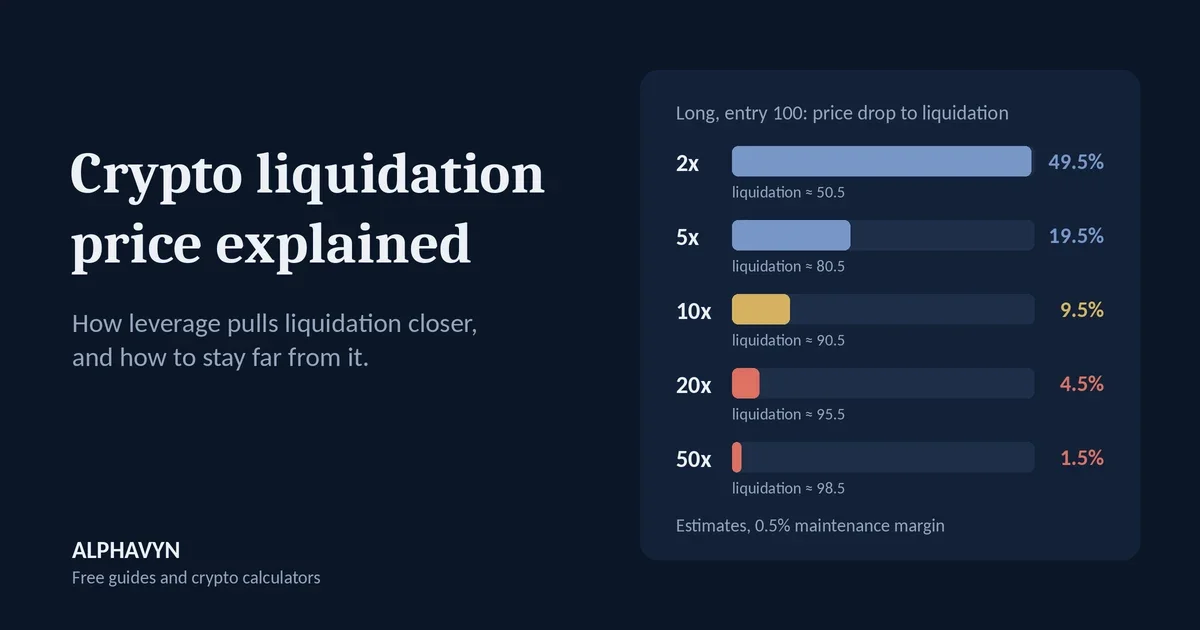
Here are estimated liquidation prices for a Long with an entry of 100 and a maintenance margin of 0.5%, using the simplified formula explained below:
Leverage | Est. liquidation price | Drop from entry |
|---|---|---|
2x | 50.5 | 49.5% |
5x | 80.5 | 19.5% |
10x | 90.5 | 9.5% |
20x | 95.5 | 4.5% |
50x | 98.5 | 1.5% |
Crypto prices can move several percent within hours, and sometimes within minutes. At high leverage, an ordinary daily move can be enough to reach liquidation.
These figures are estimates. Each platform calculates the exact level in its own way.
To see how many leveraged positions are open in the market, our guide to open interest in crypto explains how to read it.
How is the liquidation price estimated?
For a position with isolated margin, a common simplified estimate is:
Long: liquidation ≈ entry × (1 − 1 ÷ leverage + maintenance margin rate)
Short: liquidation ≈ entry × (1 + 1 ÷ leverage − maintenance margin rate)
Example (Long, 10x): 100 × (1 − 0.10 + 0.005) = 100 × 0.905 = 90.5
Example (Short, 10x): 100 × (1 + 0.10 − 0.005) = 100 × 1.095 = 109.5
For a Short, the liquidation price sits above the entry, because the position loses money when the price rises.
For why shorts carry extra risk even without leverage, see long vs short in crypto.
Why is the real liquidation price often closer than the estimate?
The simple formula leaves out several things that usually move the real level closer to your entry:
Maintenance margin tiers. Larger positions often have a higher maintenance margin rate, which moves liquidation closer.
Fees. Trading fees are charged on the full position size, not just your margin. At 10x, a 0.1% fee per side costs about 2% of your margin for a round trip.
Funding payments. Perpetual futures charge or pay a funding rate at regular intervals. If you are paying it, it slowly reduces your margin.
Mark price. Many platforms trigger liquidation using a "mark price" based on several markets, not the last traded price on your screen, so liquidation can happen at a level you did not see on the chart.
Always check the liquidation price shown by your platform before opening a leveraged position, and treat any calculator result as an estimate.
What is the difference between isolated and cross margin?
With isolated margin, each position has its own margin. If it is liquidated, you lose the margin in that position, but the rest of your balance is not used to keep it open.
With cross margin, the platform can use your whole available balance to keep positions open. This pushes the liquidation price further away, but if the market keeps moving against you, a much larger part of your balance can be lost in a single move.
Cross margin can feel safer because liquidation is further away. In practice, it often means a bigger loss when things go wrong.
Why is a stop loss better than waiting for liquidation?
A stop loss is a level you choose based on your trade idea. Liquidation is a level the platform chooses based on your margin. They are very different exits.
Example: you put 100 USDT of margin into a 10x Long at 100. The position is worth 1,000 USDT (10 coins). The estimated liquidation price is 90.5.
Exit | Price | Loss |
|---|---|---|
Stop loss | 95 | 10 × 5 = 50 USDT (half the margin) |
Liquidation | 90.5 | 100 USDT (all of the margin) |
The stop loss keeps half of the margin. Waiting for liquidation loses all of it.
Notice also how leverage changes what a normal stop costs. The same 5% stop that would cost 5 USDT on a 100 USDT spot position costs 50 USDT here, because the position is ten times larger. What you lose at the stop depends on the position size and the stop distance, not on the leverage itself. Our guide on how to calculate position size in crypto explains how to size a trade so the stop costs only what you chose to risk.
If you do use leverage, the stop loss must sit well before the liquidation price, with room for slippage and fees. If the liquidation price is closer to your entry than your planned stop, the stop can never be reached. Our guide on where to place a stop loss in crypto explains how to choose the level.
How do I use the free liquidation calculator?
The liquidation calculator gives a quick estimate:
Choose Long or Short.
Enter your entry price (100).
Enter the leverage (10).
For a Long, it shows an estimated liquidation price of about 90.5 and the percentage move needed to reach it. Try different leverage values to see how quickly the distance shrinks, then compare the result with your planned stop loss.
Frequently asked questions
Can I lose more than my margin?
With isolated margin, the loss is usually limited to the margin in that position, because the platform closes it before the margin runs out. With cross margin, your wider balance can be used to cover losses, so you can lose more than the margin you first assigned. In extreme, fast markets, the exact outcome depends on the platform's rules, so read them before trading. Crypto assets are volatile, and the U.S. SEC notes that the risk of loss remains significant.
What is maintenance margin?
Maintenance margin is the minimum amount of margin that must stay in a leveraged position for it to remain open. It is usually a small percentage of the position's value, such as 0.5%, and is often higher for larger positions. When your margin falls to this level, the position is liquidated.
Does a lower leverage remove the risk?
No. Lower leverage moves the liquidation price further away, but the position can still be liquidated in a large enough move, and losses at your stop loss still depend on the position size. Leverage never reduces risk; it only changes how much margin you put up.
Does ALPHAVYN recommend leverage?
No. ALPHAVYN does not recommend using leverage. Our signals show an entry, a stop loss, and two targets, and our position size calculator helps you size spot trades so a stop-loss hit costs only what you chose to risk.
Before opening any leveraged position, check how close liquidation could be with the liquidation calculator, and make sure your stop loss sits well before it.