Most beginners focus on finding winning trades. Experienced traders focus first on how much they can lose, because every trader has losing trades and losing streaks. Risk management is what keeps those losses small enough that you can keep trading. This guide covers eight simple rules, each linked to a free ALPHAVYN tool or a deeper guide. You can find all the calculators on the free tools page.
What is risk management in crypto trading?
Risk management is the set of decisions you make before a trade to control how much you can lose: where you exit if you are wrong, how large the position is, and how much of your account is at stake.
It does not make trades win. It decides what happens when they lose. A trader with average trade ideas and strict risk management can stay in the game for years. A trader with good ideas and no risk management can lose most of the account in one bad week.
Rule 1: What is the 1% rule?
The 1% rule means risking no more than about 1% of your account on a single trade. With 1,000 USDT, that is 10 USDT per trade.
“Risk” here does not mean the size of the position. It means what you lose if the stop loss is hit. A position of 200 USDT with a stop 5% below the entry risks only 10 USDT. The 1% is a common guideline, not a law: many traders use 0.5% to 2%, depending on experience.
Why does a losing streak hurt more with bigger risk?
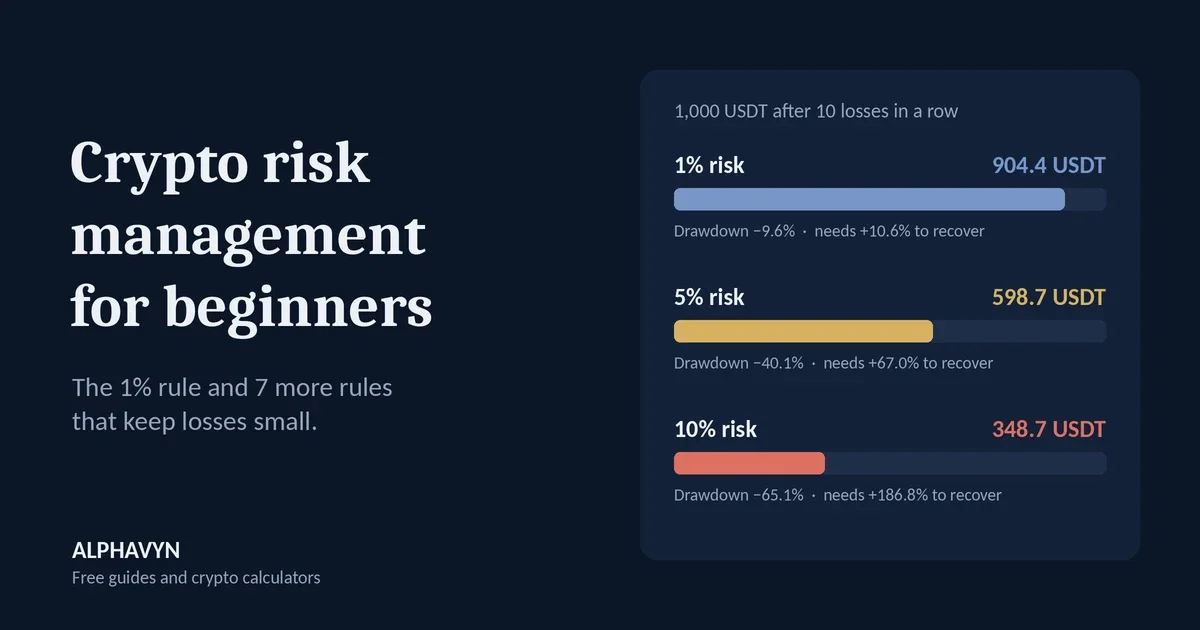
Losing streaks are normal, even for good strategies. The question is how much damage they do. Here is a 1,000 USDT account after 10 losses in a row, each risking a share of the current balance:
Risk per trade | Balance after 10 losses | Drawdown | Gain needed to get back |
|---|---|---|---|
1% | 904.4 USDT | −9.6% | +10.6% |
5% | 598.7 USDT | −40.1% | +67.0% |
10% | 348.7 USDT | −65.1% | +186.8% |
Two things stand out. First, the damage grows much faster than the risk: 10 times the risk caused almost 7 times the drawdown. Second, recovery gets harder the deeper you fall. After losing 65%, you need to almost triple what is left just to get back to the start.
At 1% risk, ten losses in a row is a bad month. At 10%, it is close to the end of the account.
Rule 2: Decide the stop loss before the entry
The stop loss is the price where your trade idea is proven wrong. Decide it before you enter, at a level that actually makes sense on the chart, and do not move it further away once the trade is open.
Our guide on where to place a stop loss in crypto compares four common methods, and our beginner’s guide to support and resistance explains how to find the levels many stops are based on. The pair analyzer shows the nearest support and resistance for any USDT pair.
Rule 3: Size from the stop, not from feelings
Once the stop is set, the position size follows from a formula:
Position size = amount at risk ÷ (entry − stop loss)
With 10 USDT at risk, an entry at 100 and a stop at 95, you buy 10 ÷ 5 = 2 coins. If the stop is hit, you lose 10 USDT, exactly the 1% you planned.
The position size calculator does this instantly, and our guide on how to calculate position size in crypto walks through more examples.
Rule 4: Check risk vs reward first
Before entering, compare what the trade could gain with what it could lose. A trade that risks 5 to make 10 has a reward-to-risk of 1: 2, which means you only need to win about one trade in three to break even, before fees.
Check any setup in the risk/reward calculator, and read our guide to the risk/reward ratio in crypto to see why a realistic target matters more than a big ratio on paper.
Rule 5: Avoid leverage, and understand liquidation if you ever see it
Leverage lets you open a position larger than your account, but it adds a liquidation price, where the position can be closed automatically, and the margin lost, sometimes before your stop loss is reached. At 10x leverage, a move of under 10% against you can be enough.
ALPHAVYN does not recommend using leverage. If you want to understand the risk, the liquidation calculator shows how close liquidation can be, and our guide to the crypto liquidation price explains why the real level is often closer than a simple estimate.
Rule 6: Count fees
Fees are charged when you buy and when you sell, so they make every win slightly smaller and every loss slightly larger. At 0.1% per order, one round trip on 1,000 USDT costs about 2 USDT; twenty round trips a month cost about 4% of the account before any profit or loss.
See what you actually keep in the crypto profit calculator, and read how to calculate crypto profit after fees for the full math, including your breakeven price.
Rule 7: Don’t chase big daily movers blindly
A coin that is up 30% today is exciting to look at, and that is exactly the risk. By the time a big move shows up on a gainers list, much of it has often already happened, and sharp rises can reverse just as sharply. Small coins with low volume can move a lot on very little trading.
Use the top gainers and losers page to see what is moving, not as a list of things to buy. If a mover interests you, plan the trade like any other: a stop at a meaningful level, a realistic target, and a size based on your risk. If the entry is already far from any sensible stop, skip it.
The same applies to adding more after a drop. Our guide on your average buy price shows how averaging down can lower your average but raise your loss, and the average price calculator tracks your real entry across several buys.
Rule 8: Keep a simple trade journal
A journal turns your trading into data you can learn from. It does not need to be complicated. For every trade, write down:
Column | Example |
|---|---|
Date | 8 Oct 2026 |
Pair and direction | BTC/USDT, Long |
Why I entered | Bounce from support |
Entry, stop loss, TP1, TP2 | 100 / 95 / 105 / 110 |
Risk (USDT and %) | 10 USDT, 1% |
Result (USDT, after fees) | +14.60 |
Did I follow the plan? | Yes / No, and why |
Review it once a week. The last column matters most: most avoidable losses come from breaking your own rules, not from bad ideas. Our guide on how to plan a crypto trade gives a ready-made planning checklist you can use for the first five columns.
How do signals fit into risk management?
A good signal gives you the levels: entry, stop loss, and targets. The risk is still yours to manage. Size every signal from your own account, skip signals whose stop would risk more than your limit, and avoid any provider that skips stop losses or promises returns. Our guide on how to read a crypto signal explains each part, and you can see how ALPHAVYN structures its signals on the free crypto signals page.
Which free tools help you manage risk?
You can do every step of this guide with our free calculators. They work in your browser and need no account.
Position size calculator: how many coins to buy so that a stop-loss hit costs only the amount you chose to risk.
Stop loss and take profit calculator: stop price from a % or a price, plus take-profit prices at 1R, 1.5R, 2R and 3R.
Risk/reward calculator: compares what a trade could lose with what it could gain, before you enter.
Break-even calculator: the exit price that covers trading fees on entry and exit, long or short.
Liquidation calculator: shows how close a leveraged position’s liquidation price sits to the entry. ALPHAVYN does not recommend using leverage.
Free live crypto charts: draw your own support, resistance and stop levels before you plan a trade.
You can find every calculator on the free tools page.
Frequently asked questions
Is 1% risk per trade too small?
It can feel small, especially with a small account. But the point is survival: with 1% risk, a long losing streak costs a manageable part of the account, and you are still there when better trades come. Many experienced traders risk 1% or less. If you increase it, do so slowly and only after your journal shows that you follow your rules.
Should I risk more when I feel confident?
Confidence is not the same as a higher chance of winning, and it is often highest right before a loss. A fixed percentage removes emotion from sizing. If you want to vary risk, use a rule decided in advance, not a feeling in the moment. ALPHAVYN’s model size works this way: Full uses all of your chosen risk per trade, and Half uses half, for setups the model rates as less strong.
What about long-term holding?
Long-term holding is a different approach from trading, but risk management still applies. Decide how much of your total savings you are willing to hold in crypto, keep it to an amount you could afford to see fall sharply, and consider spreading buys over time. Our test of Bitcoin DCA daily vs weekly vs monthly shows how a planned schedule played out with real prices, and you can test your own dates in the DCA calculator or look back with What if I invested. Crypto assets are volatile, and the U.S. SEC notes that the risk of loss remains significant.
What is the single most important rule?
Know your loss before you enter. If you always know the stop, the size, and the amount at risk before you click buy, most of the other rules follow naturally.
Start with your next trade: set the stop first, then size it in the free position size calculator so a loss costs only what you chose to risk.