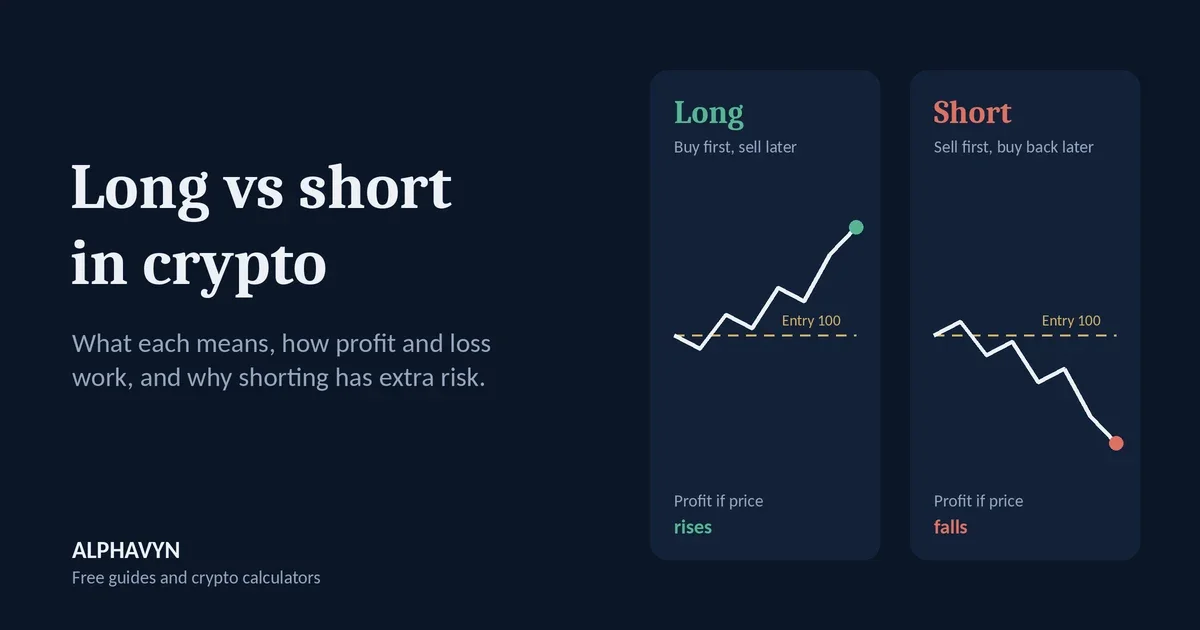
Every crypto signal, trading app, and chart discussion uses two words constantly: long and short. They describe the direction of a trade, and they change how profit, loss, and risk work. This guide explains both with simple examples, and why a short carries risks a long does not. ALPHAVYN signals show the direction of every trade, as you can see on the free crypto signals page.
What does “long” mean in crypto?
Going long means buying a coin because you expect its price to rise, and selling it later at a higher price. It is the way most people first invest: you buy, you hold, and you hope it goes up.
Example: you buy 2 coins at 100.
If the price rises to 110 and you sell, you make 2 × (110 − 100) = +20 USDT.
If the price falls to 95 and you sell, you lose 2 × (100 − 95) = −10 USDT.
On the spot market, a long simply means owning the coin.
What does “short” mean in crypto?
Going short means profiting from a falling price. You sell first, at today’s price, and buy back later, hopefully lower. The difference is your profit.
You cannot sell a coin you do not have, so a short works differently from a long behind the scenes. Most crypto shorts are opened on futures markets, using contracts that track the coin’s price, rather than by selling coins on the spot market. You never need to own the coin.
Example: you open a short of 2 coins at 100.
If the price falls to 90 and you close the short, you make 2 × (100 − 90) = +20 USDT.
If the price rises to 105 and you close it, you lose 2 × (105 − 100) = −10 USDT.
The numbers mirror the long example: same distances, opposite direction.
How do long and short compare?
Long | Short | |
|---|---|---|
You profit when the price | Rises | Falls |
Order of actions | Buy first, sell later | Sell first, buy back later |
Usual market | Spot or futures | Usually futures |
Stop loss sits | Below the entry | Above the entry |
Take-profit targets sit | Above the entry | Below the entry |
Biggest possible gain | No fixed limit | At most 100% (price falls to zero) |
Biggest possible loss | At most 100% (price falls to zero) | No fixed limit (price can keep rising) |
Why is a short riskier than a long?
There are three reasons.
1. The loss has no fixed ceiling. A price can only fall to zero, so a long can lose at most what you paid. But a price can rise without limit. If you short at 100 and the price climbs to 300, you lose 200 per coin, twice the value of the position when you opened it. Crypto prices can move very sharply in short periods.
2. Shorts usually come with liquidation. Because most shorts are futures positions, they have a liquidation price, where the position is closed automatically and the margin is lost. Even without extra leverage (1x), a short has one. Using the simplified formula from our guide to the crypto liquidation price, a 1x short at 100 with a 0.5% maintenance margin is liquidated at about 199.5, roughly where the price has doubled. With leverage, that level moves much closer. ALPHAVYN does not recommend using leverage.
3. Holding a short can cost money over time. Perpetual futures use a funding rate, small payments between long and short traders at regular intervals. Depending on the market, a short may pay funding while it is open, which slowly reduces the margin. Our guide on how to calculate crypto profit after fees explains funding and trading fees.
How do I plan a short trade?
The planning steps are the same as for a long, with the levels flipped:
The stop loss goes above the entry, at a level that would show the idea is wrong, often just above resistance. Our guide on where to place a stop loss in crypto covers this.
The targets go below the entry, often near the next support area.
The position size comes from your risk and the stop distance, exactly like a long: amount at risk ÷ (stop − entry).
Example: with 1,000 USDT and 1% risk (10 USDT), a short at 50 with a stop at 52 has a stop distance of 2. Position size = 10 ÷ 2 = 5 coins, worth 250 USDT. If the price rises to 52, you lose 10 USDT.
The position size calculator detects a short automatically when the stop is above the entry, and the risk/reward calculator works for both directions. Our guide on how to calculate position size in crypto includes a full short example.
When do traders go short?
Traders usually consider a short when the evidence points down: a falling trend, a clear rejection at resistance, or a break below support that turns the old support into resistance. Our beginner’s guide to support and resistance explains that last pattern.
Some traders also use a short to hedge, meaning to reduce the risk of coins they already hold during a period they expect to be weak. Hedging has its own costs and risks, and it is an advanced use.
Many beginners never short at all, and that is a reasonable choice. Going long on spot, with a stop loss and a sensible position size, keeps the risk simpler: no liquidation, no funding, and a maximum loss you can calculate in advance.
What does “Long” or “Short” mean on a signal?
On a signal, the direction tells you which way the trade idea points. A Long signal expects the price to rise from the entry toward the targets above it. A Short signal expects it to fall toward targets below the entry, with the stop loss above.
ALPHAVYN signals show the direction and the market (spot or futures) on every signal, together with the entry, stop loss, and two targets. Our guide on how to read a crypto signal explains each part.
Frequently asked questions
Can I short crypto on the spot market?
Not in the simple sense. On spot you can only sell coins you already own. Selling coins you hold because you expect a drop is not a short; it is closing a long. A real short, which profits from a falling price without owning the coin, is usually done with futures or with borrowed coins on margin, both of which add risks such as liquidation.
Is going long safer than going short?
A spot long is simpler: the most you can lose is what you paid, and there is no liquidation or funding. A short usually involves futures, has no fixed maximum loss, and can be liquidated. Both can lose money, and crypto assets are volatile. The U.S. SEC notes that the risk of loss remains significant.
What is a short squeeze?
A short squeeze happens when a price rises quickly, and many short traders are forced to close their positions by stop losses or liquidation. Closing a short means buying, so all that buying can push the price up even faster. It is one reason shorts can lose money very quickly.
Do the same risk rules apply to longs and shorts?
Yes. Decide the stop loss before entering, size the position so a stop-loss hit costs only what you chose to risk, check reward against risk, and count fees. Our guide to crypto risk management for beginners covers these rules for both directions.
Whichever direction you trade, set the stop first and size the trade in the free position size calculator.