Most beginners decide how much to buy by feel: "I'll put in 300 USDT, that seems fine." Position sizing flips the question. You first decide how much you are willing to lose if the trade fails, and the math tells you how much to buy. You can follow every example below in the free position size calculator.
What is position size in crypto trading?
Position size is the number of coins you buy (or sell, for a Short) in a single trade. It is usually shown in coins and in its value in USDT, for example, 2 coins worth 200 USDT.
Position size is not the same as risk. A 200 USDT position does not mean you can lose 200 USDT. If you use a stop loss, the most you plan to lose is the distance from your entry to your stop, multiplied by the number of coins. Position sizing connects these two numbers so the loss at the stop is always an amount you chose in advance.
What is the position size formula?
The formula has two steps:
Amount at risk = account size × risk per trade (%)
Position size (coins) = amount at risk ÷ (entry price − stop loss price)
For a Short, the stop sits above the entry, so the stop distance is the stop price minus the entry price. In both cases, you use the distance as a positive number.
To get the position value in USDT, multiply the coins by the entry price.
Term | What it means | Example |
|---|---|---|
Account size | Money in your trading account | 1,000 USDT |
Risk per trade | Share of the account you accept to lose | 1% |
Amount at risk | Account × risk % | 10 USDT |
Stop distance | Entry − stop loss | 100 − 95 = 5 |
Position size | Amount at risk ÷ stop distance | 10 ÷ 5 = 2 coins |
Position value | Coins × entry price | 2 × 100 = 200 USDT |
How do I calculate position size step by step?
Write down four numbers, then apply the formula. Here is a Long example with an account of 1,000 USDT.
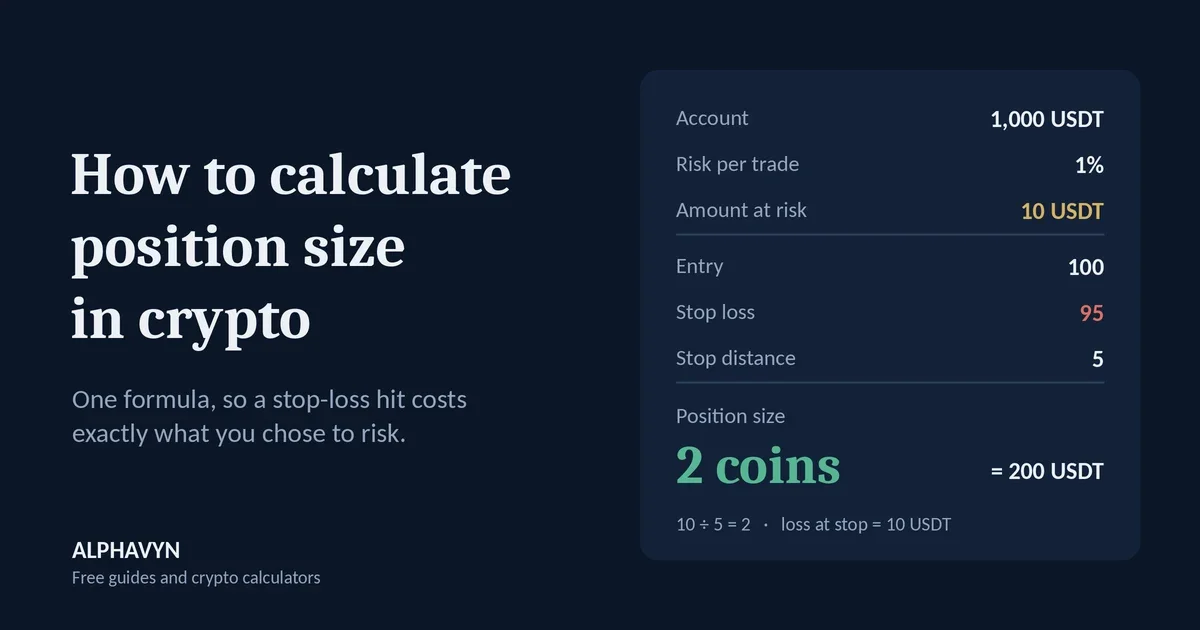
Step 1: Choose your risk per trade. Many traders keep it around 1% to 2% of the account. At 1%, the amount at risk is 1,000 × 1% = 10 USDT.
Step 2: Pick your entry. Say the entry is 100 USDT.
Step 3: Place your stop loss where the trade idea would be proven wrong. Say 95 USDT. The stop distance is 100 − 95 = 5 USDT per coin.
Step 4: Divide. 10 ÷ 5 = 2 coins, worth 2 × 100 = 200 USDT.
Step 5: Check the result. If the price falls to 95, you lose 2 × 5 = 10 USDT, exactly 1% of the account. The position is 20% of the account, but the risk is only 1%.
What does this look like for a Short?
A Short makes money when the price falls, so the stop goes above the entry. Take an account of 2,000 USDT and 1% risk, which is 20 USDT. With an entry of 0.50 and a stop at 0.52, the stop distance is 0.02.
Position size = 20 ÷ 0.02 = 1,000 coins, worth 1,000 × 0.50 = 500 USDT. If the price rises to 0.52, the loss is 1,000 × 0.02 = 20 USDT, the planned 1%.
How does the stop loss distance change the position size?
The closer your stop is to your entry, the more coins you can buy for the same risk. The further away it is, the fewer coins you buy. The amount you lose at the stop stays the same.
Using the same account (1,000 USDT), risk (1%, so 10 USDT) and entry (100):
Stop loss | Stop distance | Position size | Position value |
|---|---|---|---|
98 | 2 | 5 coins | 500 USDT |
95 | 5 | 2 coins | 200 USDT |
90 | 10 | 1 coin | 100 USDT |
In every row, hitting the stop loses 10 USDT.
This is why the stop loss should come first. Place it at a level that actually invalidates the idea, then let the formula decide the size. Moving the stop closer just to buy more coins makes it more likely to be hit by normal price swings.
Not sure where your stop should go? Our guide on where to place a stop loss in crypto explains four common methods.
What if the position is bigger than my account?
A very tight stop can produce a position larger than your whole account. With entry 100 and stop 99.5, the stop distance is only 0.5. For 10 USDT of risk, the formula gives 10 ÷ 0.5 = 20 coins, worth 2,000 USDT. That is 200% of a 1,000 USDT account. On spot, you cannot buy that much.
There are two sensible options:
Lower the risk per trade. At 0.25% risk (2.50 USDT), the size becomes 2.50 ÷ 0.5 = 5 coins, worth 500 USDT, which fits the account.
Accept that this setup does not fit your account and skip it. Not every trade idea suits every account size.
Some traders use leverage to open the full 2,000 USDT position. Leverage adds a liquidation price, where the position can be closed automatically before your stop loss is ever reached. ALPHAVYN does not recommend using leverage. If you want to see how close liquidation can be, the liquidation calculator shows it.
Our guide to the crypto liquidation price explains how leverage pulls liquidation closer to your entry.
Should trading fees be included?
Yes, if you want the loss at the stop to match your plan exactly. Fees are charged when you enter and again when you exit, so they add to the loss.
In the main example, with a fee of 0.1% per side, the fees on 2 coins are about 0.20 USDT at entry (2 × 100 × 0.1%) and 0.19 USDT at the stop (2 × 95 × 0.1%). The total loss becomes about 10.39 USDT instead of 10.
To keep the total loss at 10 USDT including fees, divide the risk by the stop distance plus the fees per coin: 10 ÷ (5 + 0.10 + 0.095) = about 1.92 coins.
Remember that the stop price is not always the price you get. The U.S. SEC's investor bulletin on stop orders explains that once a stop price is reached, the order becomes a market order and can be filled at a different price in a fast-moving market. Small extra losses from this slippage are normal, so it is wise not to size right at your limit.
Entries can slip too. A large market order on a thin coin can fill above the price you planned, which raises the risk on every coin. Our guide to market vs limit orders in crypto shows how much, with a worked example.
How do I use the free position size calculator?
The position size calculator does all of the steps above at once.
Enter 1000 in Account size (USDT).
Enter 1 in Risk per trade (%).
Enter 100 as the Entry price.
Enter 95 as the Stop loss price.
The calculator shows a position of 2 coins, worth 200 USDT, which is 20% of the account. It detects Long or Short automatically from where the stop sits.
The optional fields add more detail if you want it:
Trading fee per side: shows the total loss at the stop including fees, and the adjusted size that keeps the loss at your chosen risk.
TP1 and TP2: show the potential profit, the reward-to-risk ratio and the win rate you would need to break even. You can explore this further in the risk/reward calculator.
Leverage: only shows the margin required. Leverage does not change how much you lose at the stop loss; your position size and stop do.
The page works on any phone, so you can check your size right before you place an order.
What are common position sizing mistakes?
Buying a fixed amount every time. Spending 300 USDT on every trade means your risk changes with every stop distance, from tiny to very large.
Setting the stop after choosing the size. The stop should come first. Otherwise it ends up wherever the money "feels" right, not where the idea is wrong.
Moving the stop further away during the trade. This quietly increases the loss beyond what you planned.
Forgetting fees and slippage. They make every loss slightly larger than the clean math.
Not updating the account size. After wins or losses, recalculate 1% from the current balance, not the starting one.
Raising the risk to "win it back." Increasing size after a losing streak is one of the fastest ways to turn a drawdown into a large loss.
Frequently asked questions
Is 1% risk per trade a rule?
No. It is a common guideline, not a law. Many traders use 0.5% to 2% depending on their experience and how often they trade. The idea is that a series of losses, which every trader has, should not seriously damage the account. With 1% risk, ten losses in a row cost roughly 10% of the account.
Why not just use leverage to buy more?
Leverage makes the position larger than your account, but it does not reduce your risk at the stop. It adds a new risk: liquidation, where the position can be closed and the margin lost if the price moves against you, sometimes before your stop is reached. ALPHAVYN does not recommend using leverage.
Does position size depend on the coin?
The formula is the same for every coin. What changes is the stop distance: more volatile coins often need a wider stop, which means fewer coins for the same risk. Crypto assets can move sharply, and the U.S. SEC notes that the risk of loss remains significant.
How does this fit into a full trade plan?
Position size is one of five parts of a plan, together with the entry, stop loss, TP1 and TP2. Our guide on how to plan a crypto trade walks through all five with a complete example.
Before your next trade, enter your numbers in the position size calculator so a stop-loss hit costs exactly the amount you decided to risk.