The profit you see on a price chart is not the profit you keep. Every buy and every sell usually costs a fee, and those fees quietly reduce every win and enlarge every loss. This guide shows how to calculate your real profit, how to find your breakeven price and how much fees cost when you trade often. You can check every example in the free crypto profit calculator.
How do I calculate crypto profit?
Start with the profit before fees:
Coins = amount invested ÷ buy price
Profit before fees = coins × (sell price − buy price)
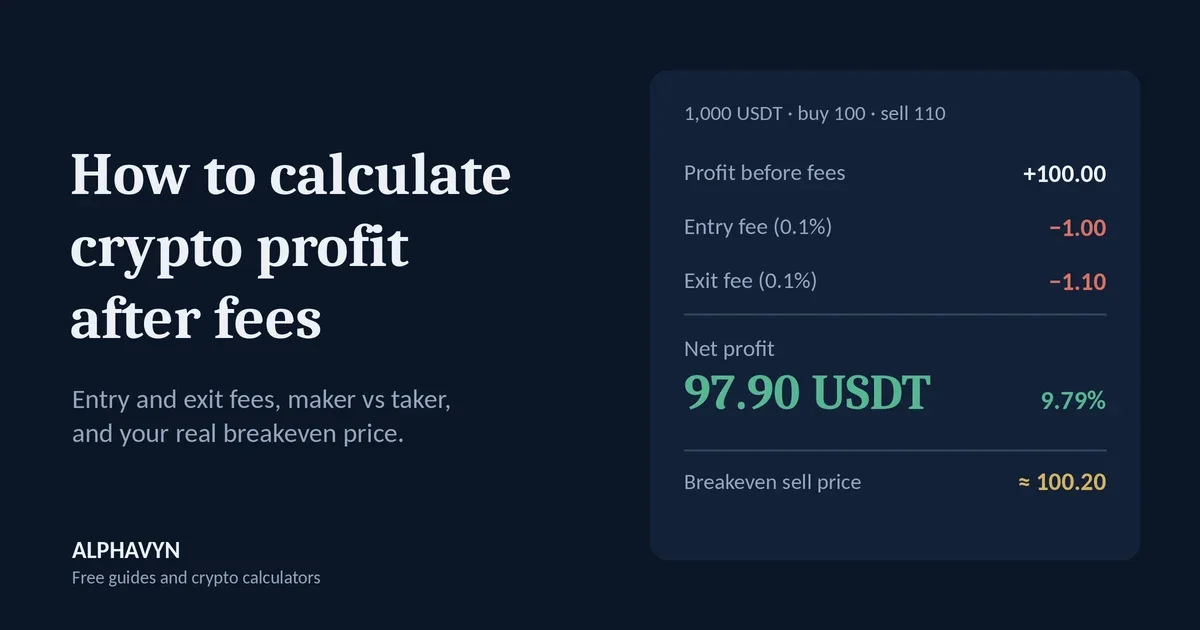
Example: you invest 1,000 USDT at a price of 100. That buys 1,000 ÷ 100 = 10 coins. You sell at 110.
Profit before fees = 10 × (110 − 100) = 100 USDT, or 10%.
That is the number most people stop at. The next step is subtracting fees.
Where do fees come in?
Most platforms charge a fee on each order, as a percentage of the order’s value. A trade has two orders, so it has two fees:
Entry fee: charged when you buy, on the value you buy.
Exit fee: charged when you sell, on the value you sell.
Net profit = profit before fees − entry fee − exit fee
Continuing the example with a fee of 0.1% per order:
Item | Calculation | Amount |
|---|---|---|
Profit before fees | 10 × (110 − 100) | 100.00 USDT |
Entry fee | 1,000 × 0.1% | 1.00 USDT |
Exit fee | 1,100 × 0.1% | 1.10 USDT |
Net profit | 100 − 1.00 − 1.10 | 97.90 USDT (9.79%) |
Notice that the exit fee is slightly larger than the entry fee, because you sell at a higher value. For this example, we assume the fee is paid separately in USDT, so you keep all 10 coins. Some platforms take the fee from the coins you receive instead, which changes the numbers very slightly.
What are maker and taker fees?
Many platforms charge two different fee rates:
Maker fee: for orders that wait in the order book, such as a limit order below the current price. These orders “make” liquidity for others to trade against.
Taker fee: for orders that fill immediately against existing orders, such as a market order. These orders “take” liquidity.
Taker fees are usually higher than maker fees. For example, a platform might charge 0.02% for maker orders and 0.05% for taker orders. Exact rates vary by platform, by market (spot or futures), and often by your monthly trading volume, so check your platform’s fee page before calculating.
Our guide to market vs limit orders in crypto explains when each order type makes sense, and how spread and slippage add to the cost of a market order beyond the fee.
A stop loss that triggers a market order is usually charged the taker fee, which is worth keeping in mind when you plan the cost of a losing trade.
What is my breakeven price after fees?
Your breakeven price is the sell price where you make exactly zero after fees. Because you pay fees on both sides, it is always a little above your buy price for a Long.
Breakeven sell price = buy price × (1 + fee) ÷ (1 − fee)
With a buy at 100 and a fee of 0.1% per order:
100 × 1.001 ÷ 0.999 ≈ 100.20
So the price must rise about 0.2% before the trade is even at zero. On a small move, fees can turn a “winning” trade into a loss.
To find the exit price that covers the fees on both your entry and your exit, use the free break-even calculator. It works for long and short trades.
How much do fees cost if I trade often?
One round trip (a buy and a sell) on 1,000 USDT at 0.1% per order costs about 2 USDT. That looks tiny until it repeats:
Round trips per month | Approx. fees on 1,000 USDT | Share of the account |
|---|---|---|
5 | 10 USDT | 1% |
20 | 40 USDT | 4% |
60 | 120 USDT | 12% |
At 20 round trips a month, fees take about 4% of the account every month before any profit or loss. A strategy has to earn more than that just to stand still. This is one reason frequent trading is harder than it looks.
How do I calculate a short trade’s profit?
A Short profits when the price falls. The formula flips:
Profit before fees = coins × (entry price − exit price)
Example: you open a Short of 10 coins at 100 and close it at 90.
Profit before fees = 10 × (100 − 90) = 100 USDT
Entry fee = 1,000 × 0.1% = 1.00 USDT
Exit fee = 900 × 0.1% = 0.90 USDT
Net profit = 100 − 1.00 − 0.90 = 98.10 USDT
Here the exit fee is smaller than the entry fee, because the position is worth less when you close it.
What about losing trades?
Fees make losses larger, too. Buying 10 coins at 100 and selling at 95 loses 10 × 5 = 50 USDT before fees. Add 1.00 USDT on entry and 0.95 USDT on exit, and the real loss is 51.95 USDT.
This is why it helps to include fees when you plan your risk. Our guide on how to calculate position size in crypto shows how to adjust the size so the loss at your stop, including fees, matches the amount you chose to risk. The position size calculator has an optional fee field that does this for you.
How do I use the free profit calculator?
The crypto profit calculator works out the profit or loss of a trade after fees, in USDT and percent. To try the example from this article:
Choose Long (buy, then sell).
Enter 1000 as the Investment (USDT).
Enter 0.1 as the Trading fee per order (%).
Enter 100 as the Buy price and 110 as the Sell price.
The calculator shows a net profit of +97.90 USDT, a return (ROI) of +9.79%, 10 coins, and total fees of 2.10 USDT, along with the profit before fees of +100.00 USDT. For a Short, choose Short and enter the prices the same way.
Fees also change how much you need from a trade to make it worthwhile. Our guide to the risk/reward ratio in crypto explains why fees make every real ratio slightly worse than the one on paper.
Frequently asked questions
Are taxes included in the profit?
No. The calculations here cover price changes and trading fees only. Taxes on crypto profits depend on your country and personal situation, so check the rules where you live or speak with a qualified tax adviser.
Why is my platform’s profit figure different from mine?
There are a few common reasons: the platform may take fees from your coins instead of in USDT, use a slightly different fill price than the one you planned (slippage), round numbers differently, or show unrealized profit based on the current price rather than a sale. Small differences are normal.
What is funding in futures trading?
Perpetual futures contracts use a funding rate: small payments between Long and Short traders at regular intervals, which keep the contract price close to the spot price. Depending on market conditions, you either pay or receive funding while the position is open. It is not a trading fee, but it affects your result in the same way. Crypto derivatives carry extra risk, and the U.S. SEC notes that the risk of loss in crypto assets remains significant.
Do fees matter on small trades?
Yes, often more. A fee of 0.1% per side means a round trip costs about 0.2% of the trade’s value, whatever its size. If your target is only 0.5% away, fees take about 40% of the gross profit. Some platforms also have minimum fees per order, which hit small trades hardest.
Check your next trade in the free crypto profit calculator to see what you actually keep after fees.