Why should you plan a crypto trade before entering?
Crypto prices can move several percent in minutes. When a trade is open and the price is moving, it is hard to think clearly. Many beginners decide where to exit only after the price has already turned against them, and that is when expensive mistakes happen.
A trade plan moves every important decision to a calm moment, before any money is at risk. You decide in advance where you enter, where you admit you were wrong, where you take profit, and how much you can lose. Then the job during the trade is simple: follow the plan.
A complete plan answers five questions:
Where do I enter?
Where is my stop loss?
Where are my targets (TP1 and TP2)?
How large should my position be?
How does the plan change for a Short trade? What will I do when each level is reached?
How do you choose an entry price?
The entry is the price where you open the trade. A good entry is a level you picked for a reason, not the price that happened to be on screen when you felt excited.
Common reasons traders use for an entry include a pullback to a former support or resistance area, a breakout above a clear range, or a level where a rule-based model scores the setup as Bullish or Bearish. Whatever method you use, write the exact price down. If the market never reaches it, you simply do not trade. Missing a trade costs nothing; entering without a plan can cost a lot.
Where should you place a stop loss?
The stop loss is the price where your trade idea is proven wrong, and where you exit to keep the loss small. It is the most important line in the plan, because it decides how much you can lose.
Place the stop at a level that would actually invalidate the idea, for example just below the support you are buying near (for a Long) or just above the resistance you are selling near (for a Short). Avoid placing it at a random percentage just because the number looks comfortable.
Our guide on where to place a stop loss in crypto compares four common methods with examples.
Keep in mind how stop orders work. According to the U.S. SEC's investor bulletin on stop, stop-limit, and trailing stop orders, a stop order turns into a market order once the stop price is reached, and in a fast market the price you actually get can be noticeably different from your stop price. This is called slippage. In crypto, which trades around the clock and can move sharply, it is wise to expect that a real loss may be a little larger than planned.
How do you set TP1 and TP2?
Take-profit targets are the prices where you plan to close part or all of the trade in profit. Using two targets gives you a simple structure:
TP1 is a closer target. Many traders close part of the position here to lock in some profit.
TP2 is a further target for the rest of the position, giving the trade room to move if the market keeps going.
Targets often sit near the next resistance (for a Long) or the next support (for a Short). The distance from entry to each target, compared with the distance from entry to the stop loss, gives you the reward-to-risk ratio.
To turn your stop and targets into exact prices, use the free stop loss and take profit calculator.
What is a good reward-to-risk ratio?
Reward-to-risk compares what you could gain with what you could lose. If your stop is 5 USDT away and your target is 10 USDT away, the ratio is 1:2.
The ratio tells you how often you need to be right just to break even, before fees:
Reward-to-risk | Win rate needed to break even |
|---|---|
1:1 | 50% |
1:1.5 | 40% |
1:2 | 33.3% |
1:3 | 25% |
The formula is: breakeven win rate = 1 ÷ (1 + reward-to-risk). A higher ratio means you can be wrong more often and still not lose money overall, but far targets are also reached less often. There is no perfect number; the point is to know the trade-off before you enter. You can test your own numbers in the free risk/reward calculator.
For worked examples and why win rate alone can mislead, see our guide to the risk/reward ratio in crypto.
How much should you buy? (position size)
This is the step most beginners skip, and it is the one that protects the account. Instead of asking "how much do I want to buy?", ask "how much am I willing to lose if the stop loss is hit?"
Many traders limit the risk on a single trade to around 1% to 2% of their account. The position size then follows from a simple formula:
Position size (coins) = amount you are willing to risk ÷ (entry price − stop loss price)
You can do this instantly with the free position size calculator.
For more examples, including Shorts and what to do when the position is bigger than your account, see our guide on how to calculate position size in crypto.
A full example: planning a Long trade
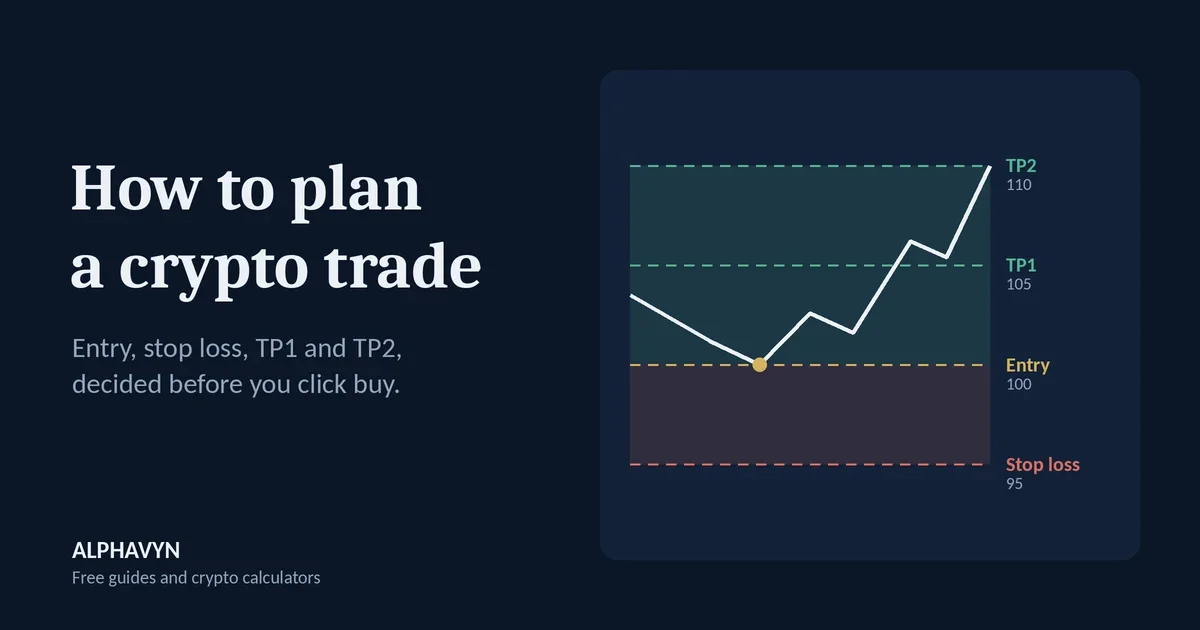
Imagine an account of 1,000 USDT and a decision to risk 1% per trade, which is 10 USDT.
Plan item | Value |
|---|---|
Entry | 100 USDT |
Stop loss | 95 USDT (5% below entry) |
Risk per coin | 100 − 95 = 5 USDT |
Position size | 10 ÷ 5 = 2 coins (200 USDT) |
TP1 | 105 USDT (1:1) |
TP2 | 110 USDT (1:2) |
What happens at each level:
Stop loss hit: 2 coins × 5 USDT = 10 USDT loss, exactly the 1% planned. With a 0.1% trading fee on entry and exit, the total loss is about 10.39 USDT.
TP1 hit, half closed: 1 coin × 5 USDT = 5 USDT profit. Some traders then move the stop on the remaining coin to the entry price, so the rest of the trade can no longer turn into a loss (before fees and slippage).
TP2 hit on the second half: 1 coin × 10 USDT = 10 USDT, for a total of 15 USDT before fees.
Notice that the position is 200 USDT, but the risk is only 10 USDT. The stop loss, not the position size, controls the loss. To see the effect of fees on any trade, try the crypto profit calculator.
Our guide on how to calculate crypto profit after fees explains the fee math step by step.
How does the plan change for a Short trade?
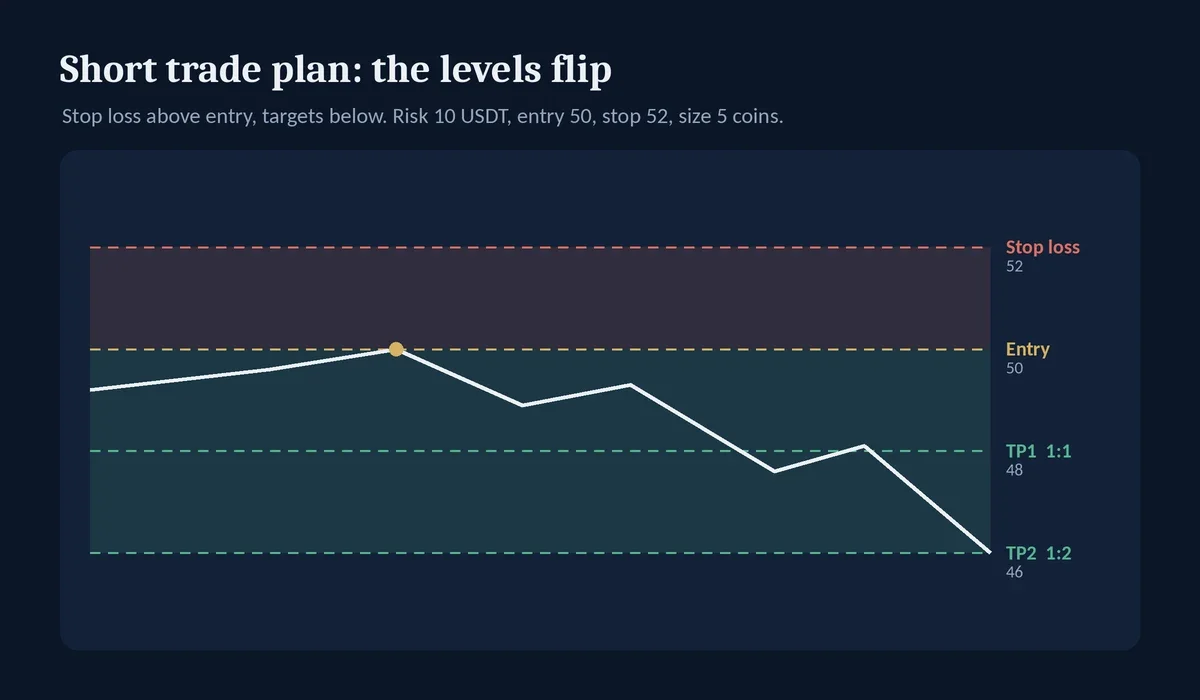
A Short profits when the price falls, so the levels flip: the stop loss sits above the entry, and the targets sit below it.
Example with the same 10 USDT risk: entry 50, stop loss 52, risk per coin 2 USDT, position size 10 ÷ 2 = 5 coins (250 USDT). TP1 at 48 is a 1:1 target and TP2 at 46 is 1:2.
What about leverage?
Leverage lets you open a position larger than your account balance, but it also brings a liquidation price, the level where the position is closed automatically and the margin is lost. With leverage, a small move against you can wipe out the trade before your stop loss is reached. ALPHAVYN does not recommend using leverage. If you want to understand the risk, the liquidation calculator shows how close liquidation can be.
What should you do after entering the trade?
Write your plan down in one line before you enter, for example: "Long at 100, stop 95, TP1 105 (close half, move stop to entry), TP2 110, size 2 coins." Then:
Place the stop loss right after entering, not "later".
Do not move the stop further away to avoid a loss. That turns a small, planned loss into a large, unplanned one.
Accept that some trades will hit the stop. A loss that matches the plan is part of trading, not a failure.
Review closed trades weekly: did you follow the plan?
A quick trade planning checklist
Question | Your answer |
|---|---|
Why am I entering here? | |
Entry price | |
Stop loss (where the idea is wrong) | |
TP1 and TP2 | |
Reward-to-risk | |
Amount at risk (USDT and % of account) | |
Position size | |
What I do at TP1 |
Frequently asked questions
Do I always need a stop loss?
A stop loss is the simplest way to know your maximum loss before entering. Crypto markets are volatile, and the U.S. SEC warns that the risk of loss in crypto assets remains significant. Trading without a defined exit leaves that loss open-ended.
Should I close everything at TP1?
There is no single answer. Closing part at TP1 and the rest at TP2 is a common middle path: it locks in some profit while leaving room for a larger move. Decide which approach you will use before entering.
How do crypto signals fit into a trade plan?
A signal that includes an entry, stop loss, TP1 and TP2 gives you the price levels, but the position size and the amount you risk are still your decision. You can see how ALPHAVYN structures each signal on the free crypto signals page.
What if the price never reaches my entry?
Then there is no trade. Chasing the price usually means a worse entry, a wider stop or a weaker reward-to-risk. Waiting for the planned level is part of the plan.
Before your next trade, run your numbers through the position size calculator so the stop loss costs exactly what you decided to risk.