Crypto never closes. You can buy Bitcoin at 3 a.m. on a Sunday as easily as at noon on a Tuesday. But the market isn’t equally active all the time. Traders around the world wake up, work and sleep in different time zones, and activity tends to rise and fall with the trading day in Asia, London and New York.
Knowing when these sessions run helps you understand why price sometimes drifts quietly for hours and then moves sharply. In this guide, we’ll go through the three sessions, their hours in UTC, how summer time changes them, and how to see them on a real BTC/USDT chart. You can turn sessions on for any USDT pair on our free live crypto charts and follow along.
Does crypto have trading hours?
No. Crypto exchanges run 24 hours a day, 7 days a week, including weekends and holidays. There’s no opening bell and no closing bell.
But people still have trading hours. Most traders are active during their own working day, and many of the large financial centers that also trade crypto follow their local business hours. So even in a market that never closes, activity is shaped by the same three regions that shape traditional markets: Asia, Europe and North America.
What are the three crypto trading sessions?
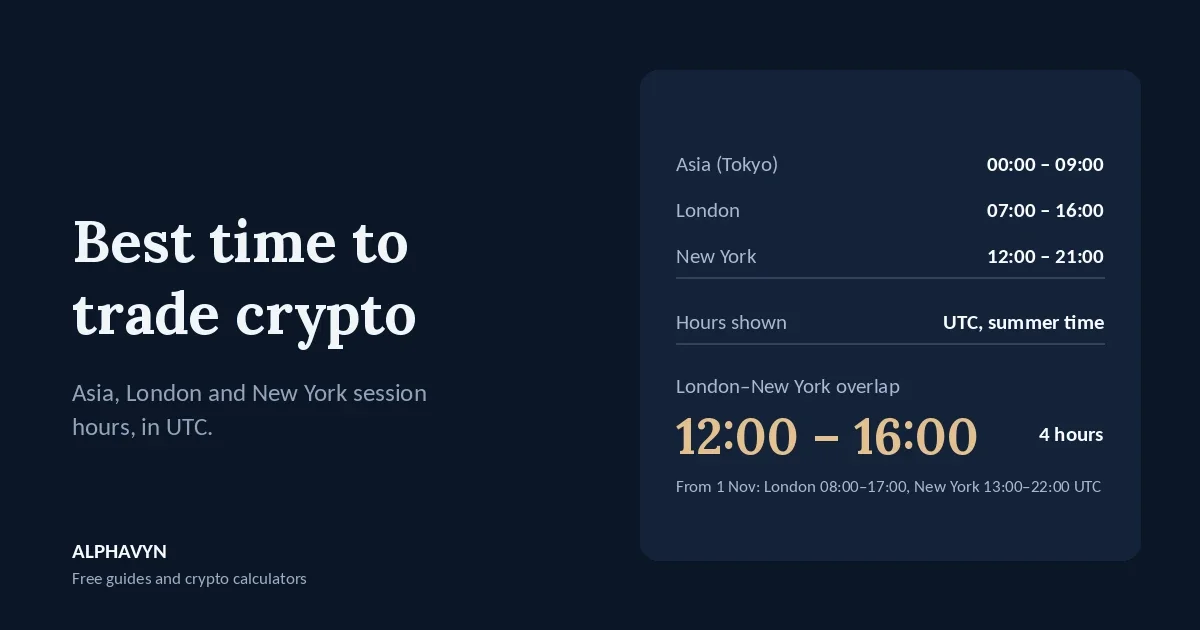
Each session is set to the business hours of a major financial center: 09:00 to 18:00 in Tokyo, and 08:00 to 17:00 in London and in New York. In UTC, that gives:
Session | Local hours | UTC, summer time | UTC, winter time |
|---|---|---|---|
Asia (Tokyo) | 09:00 – 18:00 | 00:00 – 09:00 | 00:00 – 09:00 |
London | 08:00 – 17:00 | 07:00 – 16:00 | 08:00 – 17:00 |
New York | 08:00 – 17:00 | 12:00 – 21:00 | 13:00 – 22:00 |
The sessions overlap. London opens before Asia closes, and New York opens before London closes.
When do the session times change?
London and New York use summer time, while Tokyo doesn’t. So the Asia session stays at 00:00 to 09:00 UTC all year, while the other two move by an hour twice a year.
In 2026, summer time ends on these dates:
25 October 2026: London moves from 07:00–16:00 to 08:00–17:00 UTC.
1 November 2026: New York moves from 12:00–21:00 to 13:00–22:00 UTC.
Here’s an interesting detail: because London changes a week before New York, there’s one week, from 25 to 31 October, when London runs 08:00–17:00 and New York still runs 12:00–21:00. During that week, the two sessions overlap for five hours instead of the usual four.
Our chart handles these changes automatically, so the session bands always match the real local hours of each city.
What is the London–New York overlap?
The overlap is the stretch when both London and New York are open:
Period | London–New York overlap (UTC) | Length |
|---|---|---|
Summer time | 12:00 – 16:00 | 4 hours |
25 – 31 October 2026 | 12:00 – 17:00 | 5 hours |
Winter time | 13:00 – 17:00 | 4 hours |
This is when two of the world’s largest financial centers are trading at the same time. Many traders find it the most active part of the day, with more volume and bigger moves. It’s also when the New York morning begins, and U.S. economic news, which can move all markets including crypto, often comes out during this time.
The Asia–London overlap is shorter: from 07:00 to 09:00 UTC in summer time and 08:00 to 09:00 UTC in winter time.
What happens in each session?
Every day is different, but many traders describe the sessions like this:
Asia: often calmer for major pairs, with smaller ranges. Sharp moves still happen, especially around news from the region.
London: activity often picks up as Europe starts its day, and price may break out of the range it formed during Asia.
New York: often the busiest session, especially in the overlap with London. Large moves and reversals are common in the New York morning.
Keep in mind that these are general patterns, not rules. Any session can be quiet or wild, depending on the news and the market.
How do I see trading sessions on the ALPHAVYN chart?
On our free live crypto charts, open Indicators and turn on Trading sessions. Light bands appear behind the candles for each session. In the settings, you can show Asia, London and New York on their own or together, and turn the session names on or off. Sessions show on charts from 1 minute to 2 hours.
Times on the chart are in UTC by default. Use the time button to switch to your local time, and the sessions will line up with your own clock.
Let’s look at a real one. Here’s the BTC/USDT 1-hour chart at 13:57 UTC on 22 October 2026, with price at 81,770.01, and all three sessions turned on:
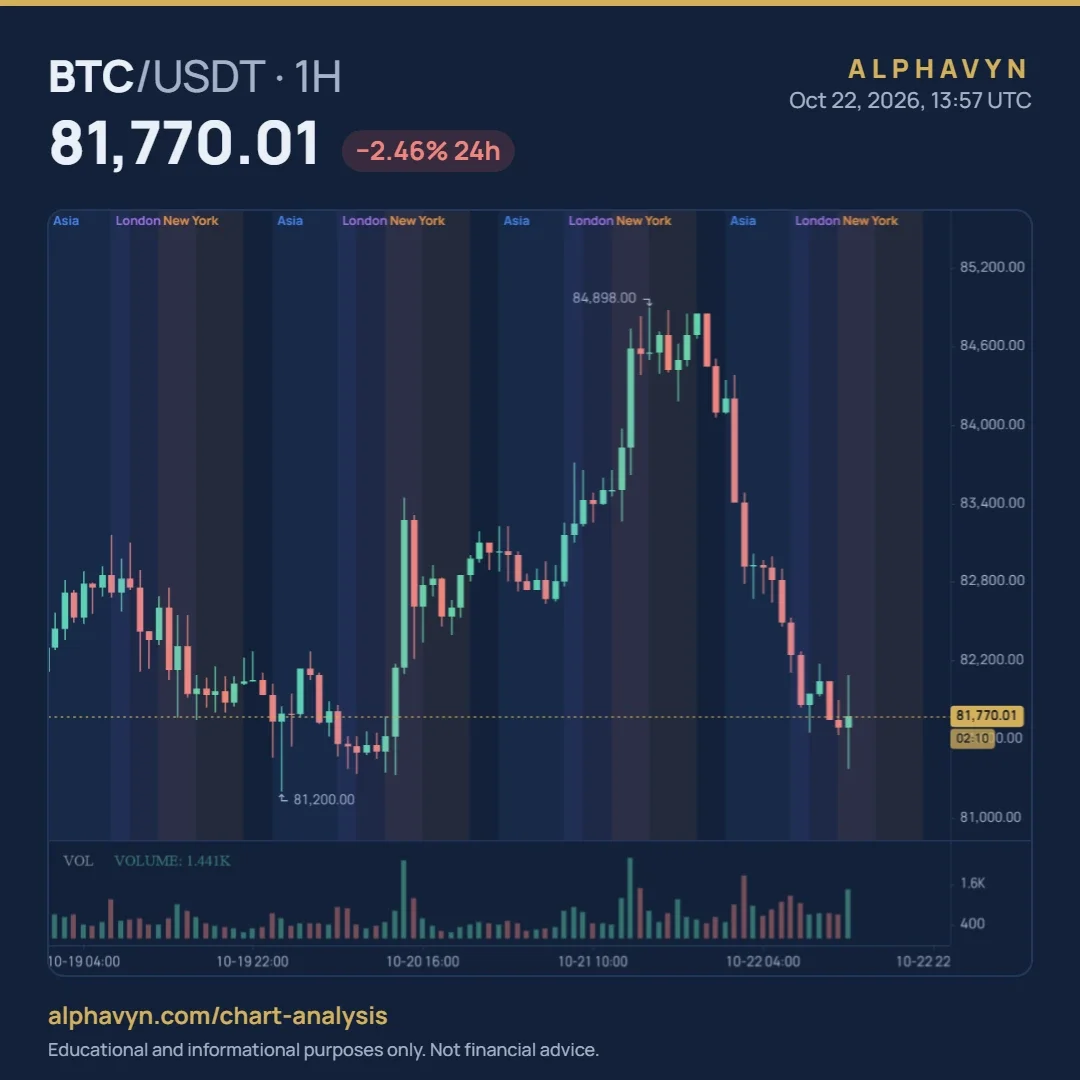
The chart shows how moves often line up with sessions, and how they sometimes don’t:
20 October: price spent the Asia session near the 81,200 low, then jumped sharply around the start of the London–New York overlap, with one of the tallest volume bars on the chart.
21 October: the rally to 84,898 also came during the London–New York overlap, again with a tall volume bar.
21 to 22 October: the sharp fall began late in the New York session and carried on through Asia and into London on 22 October. A big move doesn’t always wait for the busiest session.
So what is the best time to trade crypto?
There isn’t one best time for everyone. It depends on how you trade:
If you want movement, the London–New York overlap is often the most active time of day.
If you prefer calmer markets, the Asia session is often quieter for major pairs.
If you hold trades for days, the session matters less than your plan, your stop loss and your position size.
And here’s what matters more than the hour: trade when you can actually pay attention. A setup you can’t watch, in a session that often moves fast, is riskier than a slower one you can manage properly.
What about weekends?
Crypto trades on weekends, but traditional markets are closed, and many traders take time off. Weekends are often quieter, with lower volume.
Quieter doesn’t always mean safer. When fewer orders are waiting in the order book, a single large trade can move price further than usual, and spreads can be wider. Our guide to market vs limit orders in crypto explains why thin order books can make market orders more expensive.
How do sessions fit with other tools?
Sessions explain when activity tends to rise. They don’t show where the key levels are or which way the trend is going. Here are some common ways to combine them:
Session ranges: many traders mark the high and low of the Asia session and watch whether London or New York breaks out of it. Our beginner’s guide to support and resistance explains how to treat levels as zones.
Daily VWAP: on our chart, the default daily VWAP starts each UTC day, at the same moment the Asia session begins. Our guide on what is VWAP in crypto explains how it builds through the day.
Volume: a breakout during a busy session with high volume carries more weight than one in a quiet hour. Our guide to trend, momentum, volume and structure explains how to read volume.
And whatever the hour, every trade still needs a stop loss and a position sized so the stop costs only what you chose to risk. The position size calculator does that math for you. Fast sessions can move through a stop quickly, and our guide on where to place a stop loss in crypto explains why a small buffer helps.
Frequently asked questions
What time does the crypto market open?
It never closes, so it doesn’t open either. Crypto trades 24/7. The session times only show when major financial centers are working, which is when activity often rises.
What is the busiest time to trade crypto?
The London–New York overlap, from 12:00 to 16:00 UTC in summer time and 13:00 to 17:00 UTC in winter time, is often the most active part of the day. Busy hours vary, though, and big moves can happen in any session.
Is it better to trade crypto on weekends?
Weekends are often quieter, with lower volume. That can mean smaller moves, but also thinner order books, so a single large trade can move price more than usual. Many traders reduce their size or trade less on weekends.
How do I convert the session times to my time zone?
Add or subtract your time zone’s offset from UTC. For example, in a UTC+5 time zone, the London session in summer time, 07:00 to 16:00 UTC, runs from 12:00 to 21:00 local time. On our chart, the time button switches all times to your local time automatically.
Do the session times change during the year?
London and New York change by an hour when summer time starts and ends, while Asia doesn’t. In 2026, London moves on 25 October and New York on 1 November. Also keep in mind that crypto assets are volatile, and the U.S. SEC notes that the risk of loss remains significant.
Try it yourself
Open the free live crypto charts, switch a pair you follow to the 1-hour chart, turn on Trading sessions, and look back over the last week: note which session the biggest moves of each day started in. You’ll learn more from your own chart than from any rule of thumb.