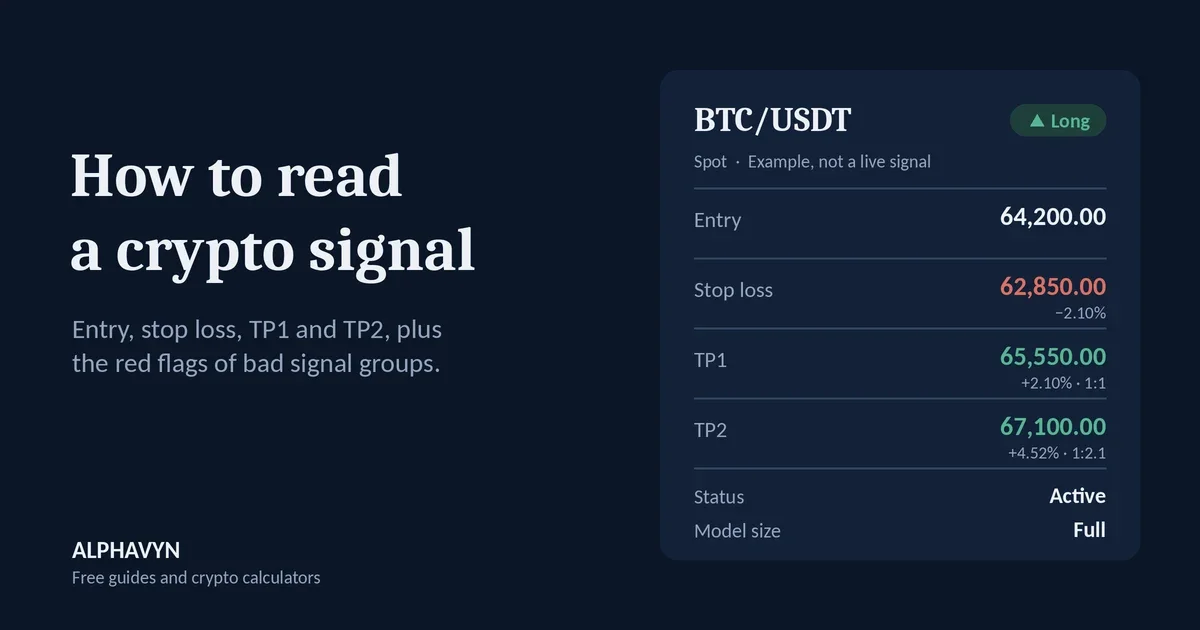
A crypto signal can be a useful starting point for a trade, or a fast way to lose money, depending on what it includes and who publishes it. This guide explains what every part of a signal means, how to turn one into a trade plan, and how to recognize groups worth avoiding. You can see how ALPHAVYN structures its own signals on the free crypto signals page.
What is a crypto trading signal?
A crypto trading signal is a trade idea with specific prices: which coin to trade, in which direction, where to enter, where to exit if the idea is wrong, and where to take profit. Signals can come from human analysts, rule-based models, or a mix of both.
A signal is not an instruction and not a guarantee. It is one input into your own decision. You still decide whether to take the trade, how much to risk, and whether it fits your account.
What should every good signal include?
A signal is only usable if it tells you enough to plan the trade. These are the parts to look for:
Part | What it tells you |
|---|---|
Pair | The coin and what it is priced in, e.g. BTC/USDT |
Market | Spot (you own the coin) or futures (a contract, often with leverage) |
Direction | Long (profits if the price rises) or Short (profits if it falls) |
Entry | The price or range to enter at |
Stop loss | The price where the idea is wrong and the trade should close |
TP1 | First take-profit target |
TP2 | Second, further take-profit target |
Status | Where the signal stands now, for example Active |
Model size | On ALPHAVYN, Full or Half (see below) |
Publish time | When the signal was published, so you know if it is still fresh |
If a signal has no stop loss, it is missing the most important line. If it has no publish time, you cannot tell whether the entry is still relevant.
How do I read a signal example step by step?
Here is an example in the same format ALPHAVYN uses. Example, not a live signal.
Field | Value |
|---|---|
Pair | BTC/USDT |
Direction | Long |
Entry | 64,200 |
Stop loss | 62,850 |
TP1 | 65,550 |
TP2 | 67,100 |
Read it in this order:
1. Direction and pair. A Long on BTC/USDT means the idea profits if Bitcoin’s price rises.
New to the terms? See long vs short in crypto, explained.
2. Stop loss first. The stop is at 62,850, so the risk is 64,200 − 62,850 = 1,350 per coin, or 2.10% below the entry. This is what you lose per coin if the idea fails.
3. The targets. TP1 at 65,550 is 1,350 above the entry, a reward-to-risk of 1 : 1. TP2 at 67,100 is 2,900 above the entry, about 1 : 2.1, or 4.52% above the entry.
4. Is the entry still available? Compare the entry with the current price. If the price has already moved far away, see the FAQ below before doing anything.
If the reward-to-risk numbers are new to you, our guide to the risk/reward ratio in crypto explains them, and you can check any signal in the risk/reward calculator.
Why are there two targets (TP1 and TP2)?
Two targets let you take some profit early and leave the rest of the trade room to run. A common approach is to close part of the position at TP1 and the rest at TP2. Some traders then move the stop loss on the remaining part to the entry price, so that part can no longer become a loss (before fees and slippage).
Using the example above, closing half at TP1 (1: 1) and half at TP2 (about 1: 2.1) gives a blended reward-to-risk of roughly 1: 1.6 if both targets are reached. Our guide on how to plan a crypto trade walks through this approach in full.
What is a split entry?
Some signals split the entry into two parts, called legs, instead of one price:
Leg 1 is active right away. It enters at or near the price when the signal is published.
Leg 2 waits for a retest. It is a limit order placed lower, near the level where the move started. It only fills if the price comes back down to that level after rising.
Example (Long): Leg 1 enters at 100 as soon as the signal is published. Leg 2 waits at 97, the level the price broke out from. If the price rises, then pulls back to 97, Leg 2 fills too. With the same number of coins in each leg, the average entry becomes (100 + 97) ÷ 2 = 98.5.
If the price never comes back to 97, only Leg 1 fills, and you hold half of the planned position. That is normal: the retest is a chance for a better price, not a promise.
Not sure how a limit order differs from a market order, or why a limit order can fill only partly? Our guide to market vs limit orders in crypto explains both with examples.
A split entry changes your risk, so calculate it from the legs you actually fill. On ALPHAVYN, each leg comes with its own levels, so work out the risk of each leg from its own entry and stop loss, and add them up for the legs that fill. If only Leg 1 fills, your total risk is just Leg 1’s risk on the smaller position.
On ALPHAVYN, split-entry signals show both legs, and the signal card shows how far the price is from the retest level, plus one combined calculator for the whole split entry.
How should I size a trade from a signal?
The signal gives you the levels. Your account decides the size. The same signal can mean 0.5 coins for one trader and 5 coins for another.
Using the example, with an account of 1,000 USDT and 1% risk per trade (10 USDT):
Position size = 10 ÷ 1,350 ≈ 0.0074 BTC, worth about 476 USDT.
If the stop loss is hit, the loss is about 10 USDT, the planned 1%, before fees and slippage. The position size calculator does this instantly, and our guide on how to calculate position size in crypto explains the formula.
ALPHAVYN signals also show a model size, Full or Half. Full means the position size calculator uses all of the risk per trade you set; Half means it uses half, for setups the model rates as less strong. In the example above, a Half signal would risk 5 USDT instead of 10, about 0.0037 BTC instead of 0.0074 BTC.
What are the red flags of a bad signal group?
Many signal groups on messaging apps are run to sell subscriptions or to move money from members to the organizers. The U.S. SEC has warned investors about fraudulent digital asset and crypto trading websites. Watch for these signs:
Guaranteed profit or fixed returns. No one can guarantee returns in crypto.
No stop loss. A signal without a stop leaves your loss open-ended.
Endless “VIP” upsells. Free signals that exist only to push you into paying more and more.
Pressure to deposit or act now. Urgency is a classic tactic to stop you from thinking.
Requests for API keys, passwords or funds. A signal provider never needs access to your exchange account or your money.
Profit screenshots without losses. Screenshots are easy to fake or cherry-pick. A provider that shows only wins is not showing you the full picture.
Signals posted after the move. If entries appear when the price has already run, you are being shown history, not a trade.
If a group shows several of these signs, the safest choice is to leave.
How does ALPHAVYN publish signals?
ALPHAVYN’s signals come from a rule-based model that scores liquid USDT pairs. A pair only becomes a signal when its score clears a threshold, so some days have fewer signals by design.
Every signal has an entry, a stop loss, and two targets.
Signals are free to use; the site is supported by ads.
Signals appear for all visitors at the same time.
ALPHAVYN never asks for exchange API keys and never holds funds.
There are no win-rate claims or profit screenshots.
You can read how the model works and what the team does and does not do on the methodology page.
Frequently asked questions
Are free crypto signals reliable?
Free or paid, no signal is reliable in the sense of being guaranteed. What you can check is whether a signal is complete (entry, stop loss, targets, time), whether the provider explains its method, and whether it avoids performance promises. Crypto assets are volatile, and the U.S. SEC notes that the risk of loss remains significant.
Should I copy every signal?
No. Treat each signal as an idea to check, not an order. Skip signals whose stop loss would risk more than your limit, coins you do not want to hold, or setups you do not understand. Taking fewer, well-sized trades is better than copying everything.
What if the entry price is gone?
Do not chase it. If the price has moved away from the entry, the trade no longer has the same risk and reward. In the example, entering at 64,900 instead of 64,200 with the same stop would raise the risk to 2,050 per coin and cut the TP1 reward to 650, a reward-to-risk of only about 1 : 0.3. It is usually better to wait for a return to the entry or skip the signal.
For split-entry signals, the second leg is designed for exactly this case: if the price returns to the retest level, Leg 2 can still fill at the planned price.
Do I need to connect my exchange to use ALPHAVYN signals?
No. ALPHAVYN only shows analysis. It never places trades, never asks for exchange API keys, and never holds your funds. You decide whether and how to trade.
See how today’s signals are structured on the free crypto signals page, and size every trade with the position size calculator.